
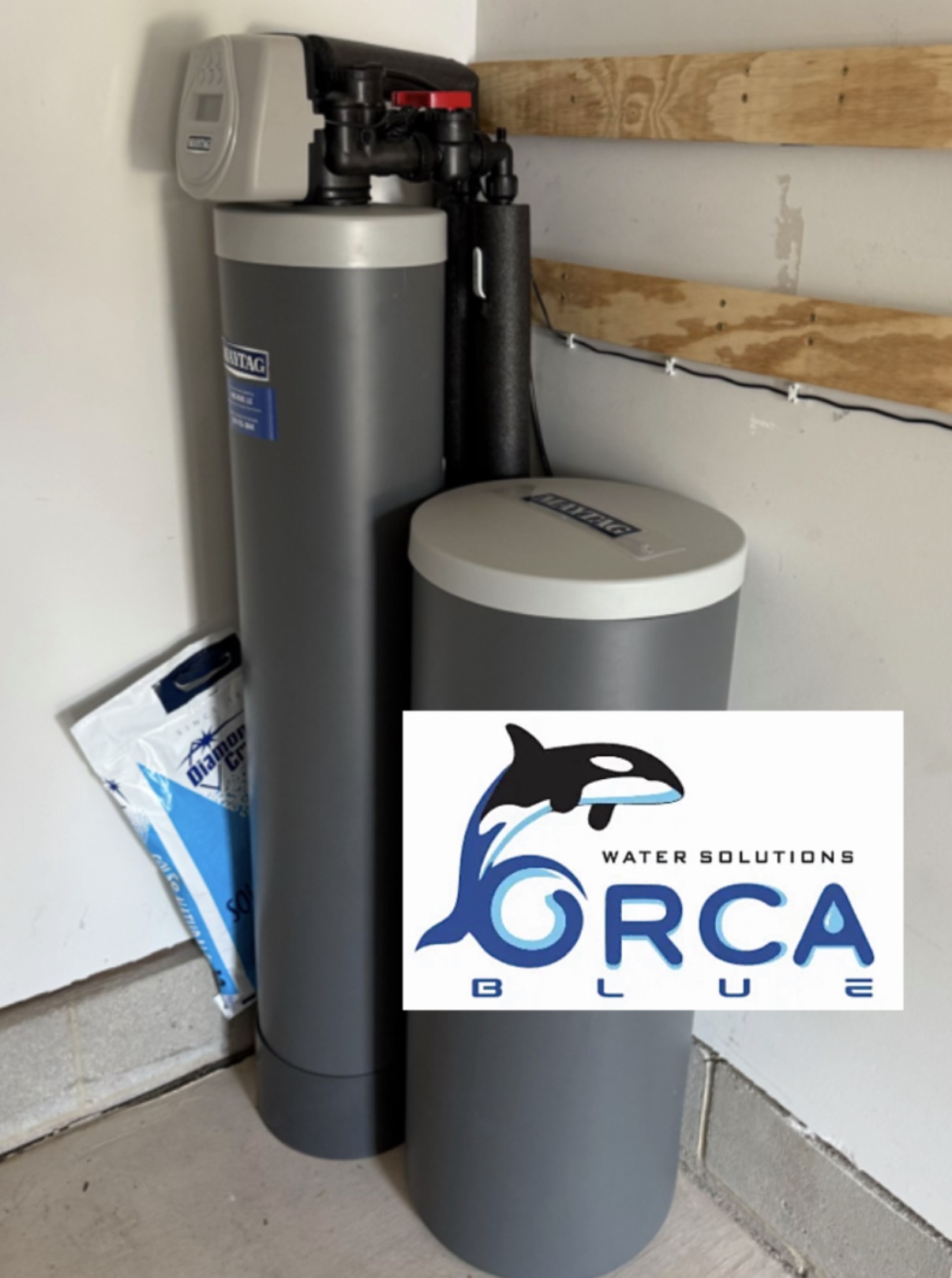
A water softener can be a great fit for some Wilmington homes
but it is not automatically the right answer for every address. Before investing in one, understand what a softener does, what it does not do, and what ongoing costs to expect. The smartest first step is a water quality test that shows whether hardness is actually a problem in your home.
At Orca Blue Water, we believe homeowners should get the full picture before choosing a water treatment system. A softener may help protect plumbing and appliances from hard-water scale, but the best solution depends on your water source, your household’s needs, and the results of your test.
What a Water Softener Is Designed to Do
Hard water contains elevated levels of dissolved minerals, primarily calcium and magnesium. Those minerals can leave scale on fixtures, make soaps harder to rinse, reduce lather, and build up inside appliances over time.
A conventional salt-based water softener
uses ion exchange to remove those hardness minerals. As the water passes through the system’s resin, calcium and magnesium are exchanged for sodium or potassium ions. That is why softened water can feel different on skin, why soap may lather more easily, and why fixtures may be easier to keep clean.
That said, a softener has a specific job: addressing hardness. It is not a universal water-treatment solution, and it is important not to buy one based on a neighbor’s experience or a one-size-fits-all sales pitch.
Downside #1: Salt Is an Ongoing Cost and Chore
Salt-based softeners need salt pellets or, in some cases, potassium chloride to regenerate the resin inside the system. This is routine maintenance, but it is still something a homeowner needs to plan for.
How often you refill the brine tank depends on several factors, including the hardness of the incoming water, the size of the household, water use, and how efficiently the system regenerates. A properly sized unit can help prevent unnecessary salt use, while an oversized, undersized, or poorly programmed unit can create extra expense and hassle.
For many families, adding salt is a manageable part of home maintenance. For others, it may be a reason to consider other approaches. Orca Blue Water talks through the expected upkeep before recommending a system, so you can decide whether it fits your routine and budget.
Downside #2: The Upfront Investment Matters
A water softener is an investment in your home, not an impulse purchase. The total cost can include the equipment, installation, plumbing considerations, setup, and future maintenance. Prices vary because homes and water conditions vary.
It is worth looking beyond the initial price tag. A system should be sized for your household’s water demand and matched to the actual hardness level in your water. Installing a system that is not needed or choosing a system that does not match the home—does not create value simply because it was the least expensive option.
Homeowners should also ask what is included, how the system will be maintained, and whether financing is available. As local water experts serving Wilmington and surrounding communities, Orca Blue Water aims to make the decision clear, practical, and affordable rather than overwhelming.
Downside #3: Softened Water Contains Added Sodium
Because a standard ion-exchange softener exchanges hardness minerals for sodium ions, the treated water contains added sodium. The amount depends on the hardness of the water and how much water is softened.
For many households, this may not be a concern. However, people on sodium-restricted diets or with specific health considerations should speak with their physician about what is appropriate for them. A water professional can explain how the system works, but personalized medical guidance should come from a qualified healthcare provider.
One option some homeowners consider is using softened water throughout the home while adding a separate reverse osmosis system at a drinking-water tap. Reverse osmosis is a different technology with a different purpose, so it should be selected based on the water test and the household’s goals.
Downside #4: Regeneration Uses Water and Creates Discharge
When the resin has collected hardness minerals, the softener regenerates. During that process, the system uses water and brine to clean and recharge the resin before it returns to normal service.
Modern, demand-initiated systems can be more efficient because they regenerate based on actual water use or measured demand rather than a fixed calendar schedule. Even so, regeneration uses water and produces salty discharge that must go to the appropriate drain connection.
This is particularly important to discuss if your home has a septic system or if you are focused on reducing household water use. The solution is not necessarily to rule out a softener; it is to make an informed choice about equipment efficiency, programming, sizing, and installation.
Downside #5: A Softener Is Not a Filter
This is one of the most common points of confusion. Water softeners target hardness minerals. They are not designed to solve every issue that affects water quality.
If you are concerned about taste, odor, chlorine, sediment, staining, iron, sulfur, or other water characteristics, you may need a different or additional treatment approach. Whole-home filtration, specialty treatment for well water, and reverse osmosis systems all serve different purposes.
For example, a homeowner might benefit from a softener for scale control and a reverse osmosis system for drinking water. Another home may need filtration without softening. The right answer starts with identifying the issue rather than assuming every water concern calls for the same equipment.
Downside #6: Your Home May Not Need One
Not every Wilmington home needs a water softener. Water conditions can differ by neighborhood, source, plumbing, and whether the home is on municipal water or a private well. A treatment recommendation should be based on what is happening in your water not on fear, guesswork, or a generic pitch.
A free in-home water test gives you a clearer starting point. It can help identify hardness and open a practical conversation about what your home actually needs. If softening is appropriate, you can compare options confidently. If it is not, you avoid spending money on a system that is not solving a real problem.
How Orca Blue Water Helps Wilmington Homeowners Decide
Orca Blue Water starts with homeowner education. During a free in-home water quality test, we show you what we find, explain what the results mean in plain language, and discuss options that fit your home.
Our goal is not to push a softener into every home. It is to help Wilmington homeowners
make a confident decision about hard water, whole-home filtration, reverse osmosis, or no additional treatment at all. If a water softener makes sense, we can help you explore efficient systems and affordable financing options. If it does not, you will know why.
FAQ
Does every home in Wilmington need a water softener?
No. Whether a home needs softening depends on its water hardness and the homeowner’s goals. A water test is the best way to determine whether a softener is worth considering.
Can a water softener improve drinking-water taste?
Not necessarily. A softener is designed to reduce hardness, not to address every taste or odor concern. Filtration or reverse osmosis may be better suited to drinking-water preferences.
How often will I need to add salt?
That varies by water hardness, household size, water use, and the system’s efficiency. A properly sized, demand-initiated system can help avoid unnecessary regeneration and salt use.
Is reverse osmosis the same as a water softener?
No. A water softener addresses hardness minerals, while reverse osmosis is a point-of-use filtration technology commonly used for drinking water. Some homes benefit from one; others benefit from both.
How do I find out what water treatment my home needs?
Schedule a free in-home water test with Orca Blue Water. You will get a clearer view of your water and recommendations based on your home not a one-size-fits-all answer.